

👯♀️ Quick Win #7: Setting up a referral program
How to Set Up a Referral Program for a Digital Loyalty Card
A referral program is one of the simplest ways to turn loyal customers into active promoters of your business. When it is connected to a digital loyalty card, the setup is straightforward, and the reward logic can be tailored to match how aggressive or how cautious you want your offer to be.
The core idea is simple. One customer invites another, and when your chosen condition is met, both people can receive a reward. That reward can be stamps, points, or any bonus balance tied to your loyalty card.
Where to find the referral program settings
Start in the Cards section from the left-side menu and open the loyalty card you already created. From there, click Edit and go to the Information section. This is where the referral program options are located.
Inside this section, the first step is to switch the referral program on for that loyalty card template.
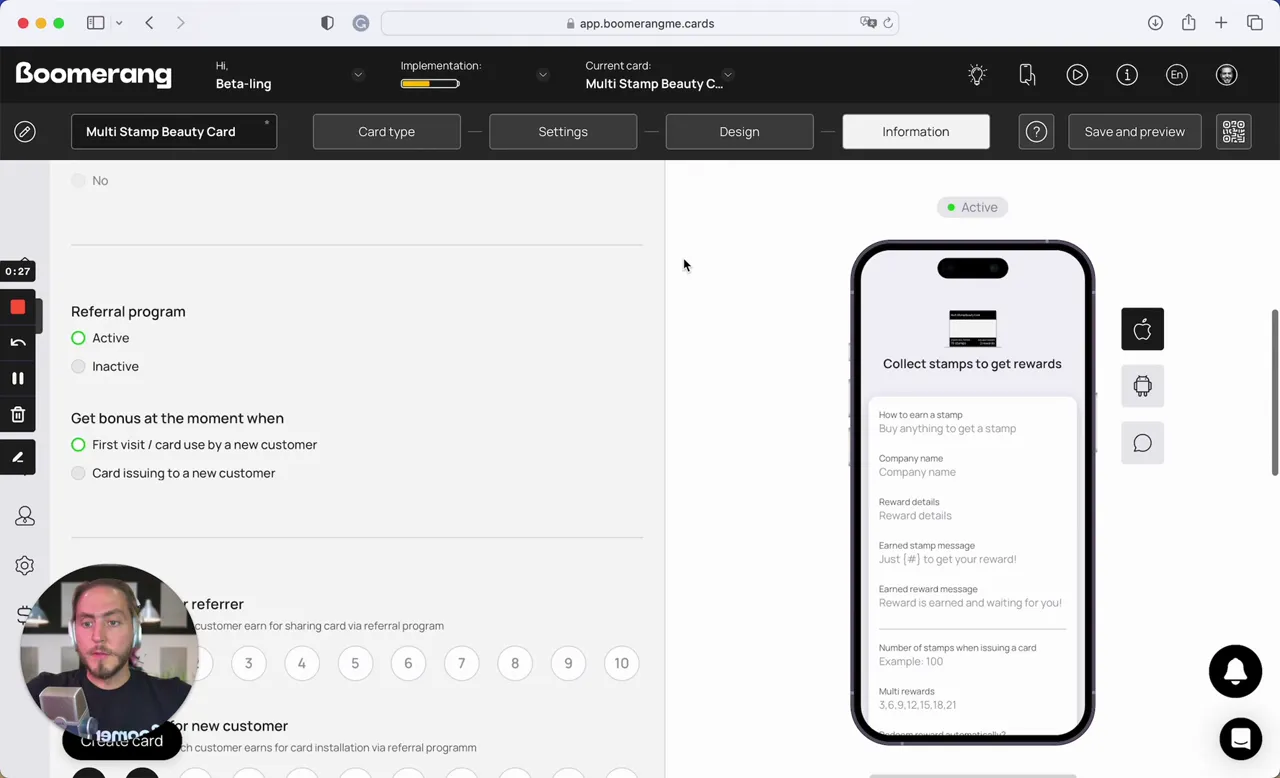
Activate the referral program on the card template
Once you are in the right section, enable the referral feature for the card. This connects the referral logic directly to that loyalty card, so the rewards are handled through the same system your customers already use.
After activation, the main job is choosing when rewards should be granted and how much each person should receive.
Choose when to reward the referrer and the invitee
There are two main ways to run this kind of referral program.
Option 1: Reward both people after the invitee makes a first purchase
This is the safer setup for most businesses. The referrer and the invited customer both receive their reward only after the new customer completes a first purchase.
Why this option makes sense:
You reward real business results, not just signups.
You avoid handing out bonuses before any revenue comes in.
You keep the program focused on customer acquisition that actually converts.
If you want a referral campaign that feels controlled and business-friendly, this is usually the best choice.
Option 2: Reward both people after the invitee sets up the loyalty card
The second option gives the reward earlier. In this version, both the referrer and the invitee are rewarded as soon as the new person sets up the loyalty card.
This can reduce friction and make the offer feel more immediate, but it is not as protective from a business perspective. A customer could receive a bonus before ever making a purchase.
That is why the purchase-based trigger is generally the more reliable setup, especially if your goal is profitable growth rather than raw signups.
Set the reward amount for each side
After deciding when the reward should happen, the next step is configuring the bonus amount.
You can define:
The referrer bonus, meaning the reward for the existing customer who invited someone
The invitee bonus, meaning the reward for the new customer who joined through the referral
The system lets you customize how many stamps or bonus points each person receives. This gives you flexibility to design the campaign around your exact goal.
How to structure your reward strategy
The best reward setup depends on what you want to encourage.
If you want to motivate existing loyal customers
You can make the offer more attractive to the referrer than to the new customer.
For example:
Give the referrer 2 stamps
Give the invitee 0 points
This structure puts all the incentive on the person already connected to your business. It works well when your main priority is getting loyal customers to bring in friends or family members.
In other words, the invitation itself becomes the behavior you are rewarding.
If you want a balanced incentive for both people
You can split the reward evenly.
For example:
Give the referrer 1 stamp
Give the invitee 1 stamp
This is a more symmetrical approach. It gives the existing customer a reason to refer and gives the new customer a reason to complete the action that triggers the bonus.
It is a good fit when you want the promotion to feel fair and mutually beneficial.
Which referral setup is best for most businesses?
For most cases, the strongest combination is:
Reward both people after the invitee makes the first purchase
Choose a reward amount that reflects the value of a new paying customer
This gives you a referral program that is simple, measurable, and safer from a budget perspective. You are not just rewarding interest. You are rewarding actual conversion.
If your business wants a faster, easier entry point, the setup-based reward can still work. But if you are looking for a more dependable model, the purchase-triggered option is usually the smarter path.
A simple example of referral logic
Here is what a practical referral flow can look like:
An existing customer shares the loyalty card invitation with a friend.
The friend joins and sets up the card.
The friend makes a first purchase.
The system automatically adds the configured reward to the referrer.
The system also adds the configured reward to the invitee, if you chose to reward both sides.
That is really the whole mechanism. Once the rules are selected and the reward amounts are configured, the rest is handled automatically through the loyalty card settings.
Keep the program focused and easy to understand
A referral campaign does not need to be complicated to work well. In fact, the simpler it is, the easier it becomes for customers to participate and for your business to manage.
When setting up your referral program, keep these principles in mind:
Use a clear trigger so customers know exactly when rewards are unlocked
Match rewards to your goal, whether that is more referrals, more purchases, or both
Favor purchase-based rewards if you want a safer and more sustainable setup
Adjust bonus amounts carefully so the program stays motivating without becoming too costly
Once these settings are in place, the referral program becomes one of the easiest loyalty mechanics to launch. The setup is quick, the logic is clear, and the rewards can be shaped around the kind of customer behavior you want most.